North to South: What Changes When Diving Komodo?
Explore Wallacea’s Komodo National Park liveaboard itineraries to see how one journey can move through very different underwater environments. For many divers, diving in Komodo is memorable because conditions, coral communities, visibility, temperature, and marine encounters can change dramatically between the north, central, and south.
Komodo National Park sits between Sumbawa and Flores and includes Komodo, Rinca, Padar, and numerous smaller islands. UNESCO describes its seas as exceptionally rich, shaped by strong currents and the rapid exchange of nutrient-rich water. The wider Komodo Biosphere Reserve supports more than 260 species of reef-building coral and more than 1,000 species of bony fish.
Why Does the Underwater Landscape Change So Much?
The biggest factor is water movement. Komodo lies in a complex channel system where currents move between islands and through narrow straits. Those currents redistribute nutrients and create a mosaic of hard-coral gardens, soft-coral slopes, pinnacles, walls, manta areas, and macro-rich sites. UNESCO identifies strong currents and coral reefs as defining characteristics of Komodo’s marine environment.
The reason diving in Komodo can feel so dynamic is that water temperature, visibility, current direction, and tidal timing can shift quickly. Wallacea notes that currents may change from day to day, hour to hour, and even during a single dive. Experienced guides therefore plan entries carefully and adapt the schedule to conditions.
North Komodo: Clearer Water, Hard Corals and Big-Fish Energy
North Komodo is often associated with warmer, clearer water and large hard-coral formations. Wallacea describes a mixture of hard and soft corals alongside anthias, wrasse, angelfish, reef sharks, tuna, trevallies, barracuda, and manta rays. On one August itinerary, Wallacea lists temperatures around 28°C in the north and generally excellent visibility.
Northern sites such as Castle Rock and Crystal Rock are known for current, schooling fish, and pelagic action. The Komodo National Park dive-site guide describes Castle Rock as having excellent visibility but strong currents, with barracuda, trevally, mackerel, soft corals, and sea fans.
For travelers researching Komodo Island diving, the north represents the high-energy side of the destination: blue water, schools of fish, current-swept pinnacles, and broad reef scenery. It suits divers who enjoy wide-angle photography and active dives.
Central Komodo: Current, Coral Variety and Manta Corridors
Central Komodo brings many celebrated sites close together. Batu Bolong is a classic example: a small rock surrounded by steep reef walls, colorful corals, reef fish, sharks, Napoleon wrasse, giant trevally, and dogtooth tuna. Because the current can be intense, the official park guide recommends diving around slack tide.
Nearby Tatawa Besar offers drift-diving opportunities, while manta aggregation areas add another dimension. Central Komodo can feel like a bridge between northern big-fish action and the cooler, more invertebrate-rich environments farther south.
A key lesson from diving in Komodo is that the “best” site depends as much on timing as on location. A famous Komodo dive site may be ideal at one stage of the tide and unsuitable shortly afterward. That is one reason a Komodo liveaboard can be valuable: the vessel and dive team can adjust the sequence rather than rely on a fixed day-trip schedule.
South Komodo: Cooler Water, Soft Corals and Macro Detail
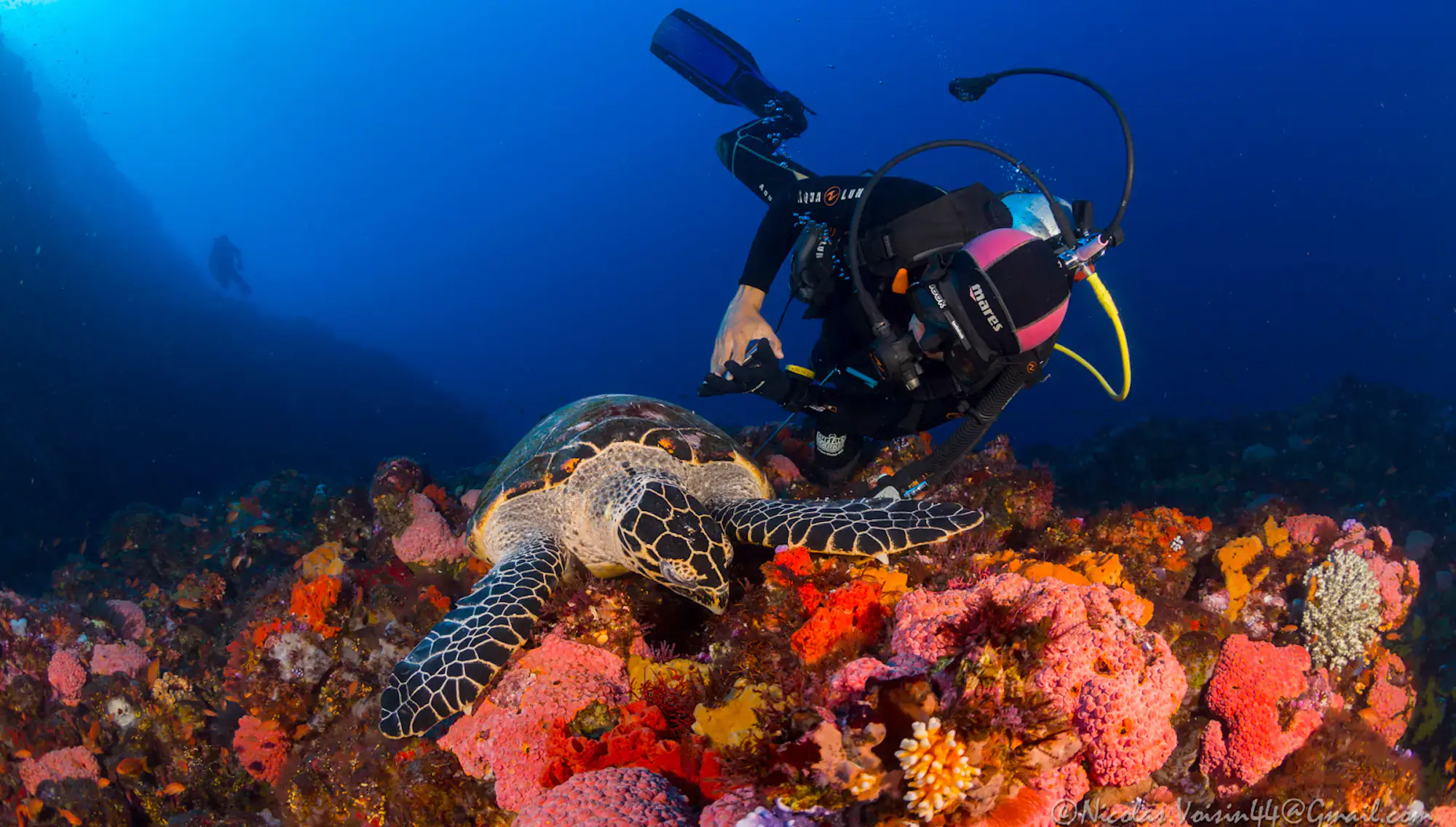
Travel south, and the underwater character changes noticeably. Wallacea describes southern Komodo as richer in soft corals, vivid colors, and macro life, with cooler water and opportunities to encounter manta rays. Its August itinerary notes that southern temperatures can fall to roughly 22–23°C, compared with about 28°C in the north.
The official park guide also describes southern sites with colorful walls, feather stars, sea apples, nudibranchs, pygmy seahorses, frogfish, and other invertebrates. Cannibal Rock, for example, is known for dense soft-coral growth and unusual small marine life.
For photographers, the shift can be dramatic. One day may be dominated by reef sharks and schooling fish; another may reward slow observation of tiny critters against soft-coral backgrounds. This contrast is one reason Komodo diving works especially well as a multi-day journey.
Why a Liveaboard Makes the Differences Easier to Experience
A multi-day diving boat lets divers follow the geography instead of returning to the same harbor each day. Wallacea’s 10-night Bali-to-Labuan Bajo itinerary schedules time in North, Central, and South Komodo and lists a minimum of 33 dives, including night dives. Its published inclusions also state a maximum ratio of one guide to four divers and complimentary Nitrox for certified divers.
That format makes a dive cruise useful for experiencing warm northern reefs, current-driven central sites, and cooler southern habitats in a single expedition.
Komodo is also part of a UNESCO World Heritage property covering 219,322 hectares, recognized for both terrestrial and marine biodiversity. For anyone comparing diving in Indonesia, the combination of currents, coral diversity, pelagic encounters, macro life, and rapid environmental change gives Komodo a distinctive identity.
So, Which Part of Komodo Is Best?
There is no single winner. North Komodo suits divers drawn to clear water, reef structure, schooling fish, and current-fed action. Central Komodo delivers iconic sites, drift dives, coral variety, and manta opportunities. South Komodo shifts toward cooler water, soft corals, invertebrates, and macro photography.
That variety is why diving in Komodo works best when the itinerary remains flexible. Conditions determine which sites are safest and most rewarding on a given day, so an experienced crew can be as important as the destination list itself.
If you want to experience the contrasts rather than choose only one zone, explore Wallacea’s routes through Komodo National Park and compare itineraries connecting the north, central, and south in one journey.